

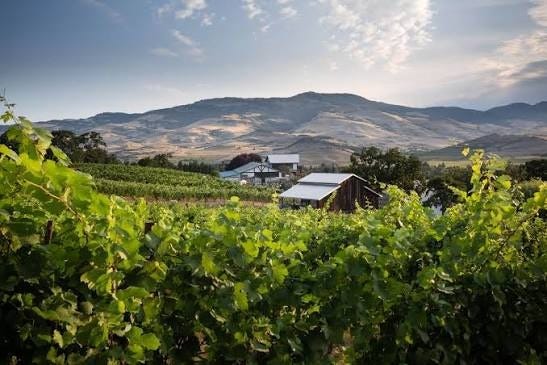
USA Today recently surprised the wine world with one of its 2026 “Best of Reader’s Choice “ Awards. The category was the most exciting wine region to visit.
It was no surprise to see rapidly rising places like the Anderson Valley in Mendocino and Paso Robles in the Central Coast making the top ten.
But the #1 region, the very best, was the Rogue Valley in Southern Oregon.
You heard right. Its famous, prominent neighbor to the north, the Willamette Valley placed #8.
No fan of “Best of” articles, aka listicles in general, I nevertheless thought the fact that the Rogue Valley topped the list should have been a headline article in every wine publication, blog or whatever.
But as a small, relatively new region without a bigtime promotional budget for media samples and trips, it flies well under the radar of most writers. So after a brief local flurry, this newsworthy item quickly went into the “old news” dumpster.
And for that reason, chances are most wine lovers outside of Oregon would be hard pressed to name one Rogue Valley winery.
USA Today’s editors singled out the region for its diversity of micro-climates and variety of successful wines as well as fun activities like fishing, hiking, and attending music events and theaters.
It has all of that and, as someone who has spent considerable time there over the last 5 years, I’d like to offer an insider look at this overlooked region.
To me, the Rogue Valley is an ideal region to experience first hand a wide variety of wines, kind of a DIY self-education WSET field trip.
A Few Boring Facts
Taking its name from the Rogue River, the Rogue Valley was approved as an AVA in 1991 which makes it relatively new in wine years. It is the southernmost growing wine region of Oregon. It is also large in size being 70 miles wide by 60 miles long.
The AVA runs from Ashland in the southeast through the north and south sides of Medford and stretches to Grants Pass in the west. Today. What makes this diversity possible is that vineyards are planted at different elevations with different aspects and soils which lead to a wide range of opportunities.
While most of today’s wineries started after 2000, the Rogue Valley is actually Oregon’s oldest wine region, with first vineyards planted in the 1850s. And it is home to the State’s first operating winery opened in 1873.
Total vineyard acreage today is over 4,000, and the number of wineries and brands is close to 100. The average annual winery production is around 2000 cases.
The Wine Grape Galaxy
The Rogue Valley grows 70 different varieties and does extremely well with many, whether Spanish, Rhone, Italian and French in origin.
No signature wine has yet to emerge, though Tempranillo and Rhone varieties are strong candidates.The micro-climates are so diverse that you can explore Albarino and Vermentino, Gruner Veltliner, Grenache and Gewurztraminer, Riesling and Roussanne.
You could spend a full day exploring trending wines like Cabernet Franc, and comeback wines like Chenin Blanc and Riesling. Italian varieties are less common, but there are plantings and varietal wines of Barbera, Teroldago, and Montepulciano.
Truly obscure varieties like Negrette can be found at Troon and Tannat at Weisinger Family. BTW: Both versions are outstanding.
While the focus here is on varietal wines, blended wines are another part of Rogue Valley wines. To pick one to represent what the region’s blends have to offer, I’m going with an exciting blend from Peter William aptly named “Extravagance.”
Here’s my review posted at winereviewonline.com
Peter William Vineyard Rogue Valley (Oregon) Extravagance 2021 $42
This is the third vintage of this unusual blend of Syrah and Tempranillo I’ve tasted, and is another remarkable success. The final blend for this 2021 “Extravagance” was 51% Syrah and 49% Tempranillo with French oak aging in 75% new barrels for 20 months. Deep in color, it offers an aroma of black fruit with some pepper and spice. With the Tempranillo contributing structure and a touch of licorice, the palate is rich with lots of Syrah black fruit and earthy flavors. Oak and light tannins provide some grip to the finish, suggesting it will reward several years of cellaring. 93 points
(For anyone thinking about skipping theis course, but still curious, go the winereviewonline.com and search Rogue Valley.)
Let’s Begin the Course
In 2026, Valley View Winery, the oldest winery that’s located in the western end sub-region of the Applegate Valley, is celebrating its 50th anniversary. The Wisnovsky family, now run by the 3rd generation, reminds us that family owned wineries with a hands-on approach in the vineyard and cellar are common threads here.
Typical of the region, its roster is diverse with excellent Syrah, Tempranillo, with Riesling and Pinot Noir under its Domaine Rogue label.
On the eastern edge in Ashland, the Weisinger Family Winery opened in 1988 and is in the hands of the second generation. The first generation began by focusing on Gewurztraminer, but Tempranillo soon became a featured grape.
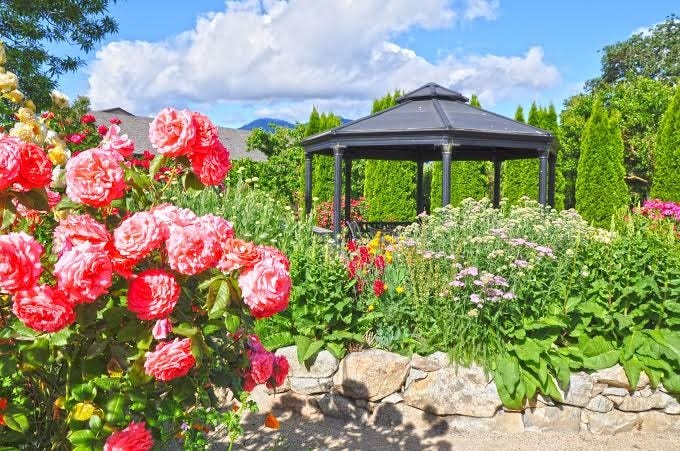
Close to Grants Pass, the third oldest winery is the Schmidt Family Vineyard which, with its magnificent garden setting and fine wines, brings home the fact that the Rogue Valley is all about family owned wineries, not corporations.
Back to the Present
The 2026 harvest confirms that the Rogue Valley is different in many ways. In mid-September when Napa Valley winemakers were winding down the harvest, their counterparts in the Rogue Valley were just getting into full swing.
For today’s curious wine lovers, the best news is that many wines now coming to market are from the 2025 vintage. It happens to be one of the finest in recent years. The whites tasted have borne that out.
Peter Adesman, who owns Peter William Vineyard and is one of the top producers, can’t conceal his enthusiasm for all wines, red, white and rose made in 2025.
One interesting sidebar here is that the Rogue Valley was the only region in Oregon where both the number of vineyards involved and the quantity of the harvest increased in 2025.
New wineries are popping up to sustain the surge and to add to the excitement. It has not escaped the problems encountered around the world with a few vineyards up for sales and tasting rooms traffic varying from earlier years. But overall, there’s so much going on now, so this is a great time to hop aboard.
Over the last two months, I was lucky to discover a few new and exciting kids on the block.
There’s nothing predictable or routine with these Rogue newbies. For example, the Sound and Vision Winery wowed me with its 2023 Vermentino, and the folks behind Punch House Winery showed a rich 2025 Rose that rivals the best from Bandol.
Then along came a Roussanne from Twelve 32 Cellars which also has a stunning Petite Sirah. How’s that for an odd couple, and both are stylish. not overdone.
Speaking of odd, Grit Cellars is also new to the scene and made an outstanding blend of Grenache and Tempranillo in 2023. Creative blends are a key component to understanding the Rogue Valley.
Grit also made a sparkling 2024 Sauvignon Blanc, a new experience for me that I later learned with a little help from A1 may actually be part of a developing trend. Who knew.
Your 7 Step DIY Wine Education Itinerary
So, with this background, let’s get back and work on the classroom possibilities for those interested in becoming a Rogue’s Scholar. So let’s hit the road, Jack. Or make a new plan, Stan.
Introduction to the Region, Wine Styles and Vineyards
The Weisinger Family Vineyards located in Ashland is the perfect place to begin your journey with its wide offering. Seek out its Tempranillo and Grenache, both successful each year as well as its Sauvignon Blanc. Look for one of Eric Weisinger’s blends, the 2022 Claret is amazing. On my last visit, he wowed my family with a Gewurztraminer and Cabernet Franc.
Demeter and Organic Farming
Troon Vineyards
Rogue Valley winemakers share an enthusiasm for sustainable farming and organic practices. The place to learn the latest about vineyard management is Troon. Tucked away in the Applegate Valley, Troon is the real deal when it comes to farming. It is a Demeter Biodynamic® Regenerative Organic CertifiedTM Farm which is populated by bees, sheep, and chickens. My first visit convinced me that quality starts in the vineyard and that organic practices make a difference. It cultivates 20 different varieties, including Negrette and Tannat. As for wines, try the Vermentino, Viognier and Roussanne.
Rhone Centric Focusing on Grenache, Syrah and Blends
Quady North
Not far from Troon, Quady North in the Applegate Valley offers a Rhone centric crash course. You can try Syrah from different blocks of the estate vineyard or learn about the region’s most successful GSM. Here you’ll also find a textbook Cabernet Franc and Mourvedre which should be part of your study. But Syrah is the real deal. Here’s my recent review of a stunning Mae’s Vineyard Syrah:
Quady North began in 2006 and Herb Quady now offers several versions of Syrah. Mae’s Vineyard is part of the estate holdings. The 2022 was co-fermented with 4% Viognier, and the wine was aged for 20 months in 20% new French oak. The wine needs a little time to reveal a bouquet of ripe dark fruit, subtle grilled meat and a lavender-like floral component. Medium-bodied with concentrated flavors that are multi-layered, it is vibrant and tantalizing with a touch of oak spice coming through in the finish. Attractive now, this will nevertheless respond well to aging over the next several years. 93 points
Tempranillo Clones, Styles and History
Tempranillo is made by dozens of wineries, but both Valley View Vineyards and Kriselle Vineyards are must visits. Their versions are textbook perfect, and both can offer loads of viticultural background info. Valley View makes its Tempranillo from the Valley’s oldest plantings.
It also make a Rogue Red blend and lot #32, made from Syrah and Grenache, is at $14, one of the great values in red wine from anywhere.
Red Lily Vineyards has emphasized Tempranillo since it started out in 2008 when vines were established along benchlands of the Applegate River. Here, Rachael Martin makes Tempranillo in three styles, including a Rose. A rare Verdejo is another of her specialities.
White Wines Other Than Chardonnay
One of the most beautiful settings is also a great place to learn about Rogue Valley white wines, Schmidt Family. Here, you’ll find excellent examples of what this region can do with varieties likeAlbarino, Gruner Veltliner, Viognier, Pinot Gris, and Sauvignon Blanc.
On its 40 acre estate vineyards, Schmidt Family Vineyards in Applegate Valley grows 14 varieties, and produces 6,700 cases a year. It also makes 25 different wines in a given year.
Bordeaux Red Varieties
While generally warmer than the Willamette Valley and cooler than Napa, the Rogue Valley can turn out Bordeaux reds that often remind me of wines made in Bordeaux. Crooked Barn focuses on them and is an over-achiever in many ways with both Cabernets.
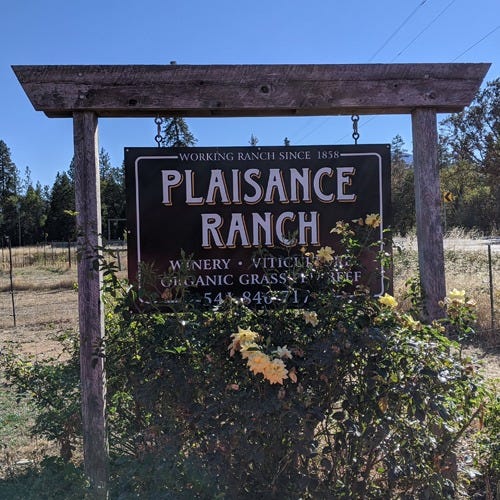
Merlot, Malbec and Carmenere are doing very well at Plaisance Ranch. A real working ranch with 157 acres devoted to certified organic vineyards and to grassy pastures feeding beef cattle. Most of the land is devoted to pastures. Now run by third generation farmers, Suzi and Joe Ginet who also make a Mondeuse.
Pinot Noir Clones
Dancin Vineyard
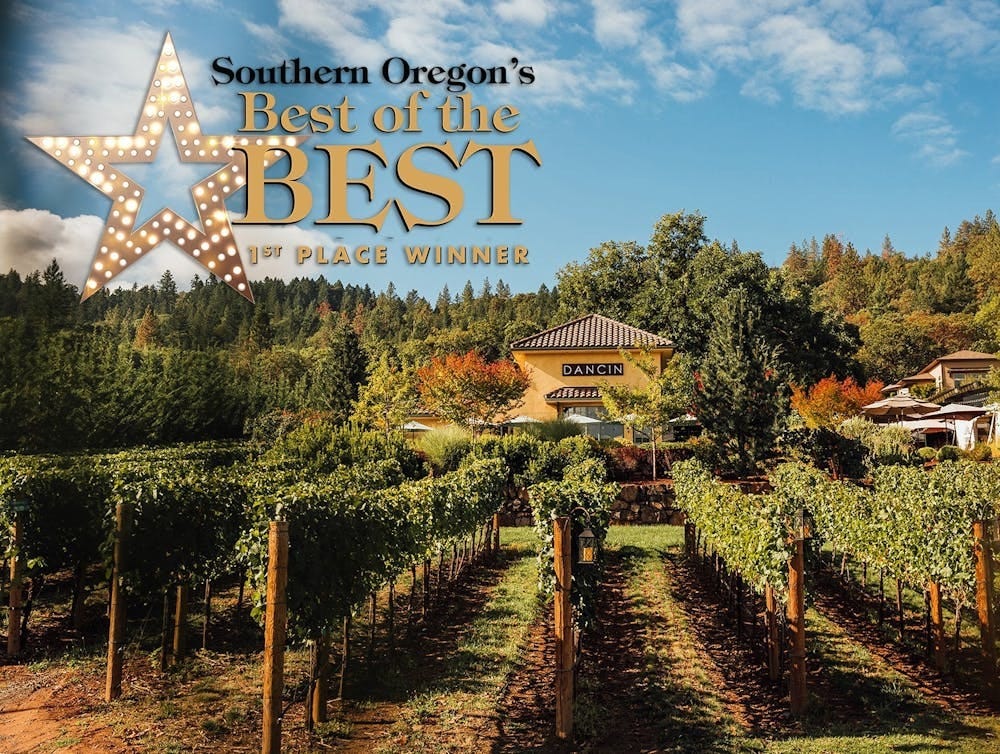
Overlooking its beautifully terraced, immaculate vineyard in Jacksonville, Dancin is the place to dive into the Rogue Valley’s Pinot Noir. Here you’ll learn about clonal selection and vineyard management techniques for Pinot. Seven clones are grown here…5 being Dijon, 1 Wadenswil, and 1 Pommard. Learn what each has to offer and how clones came to be so key to Pinot Noir quality. Dancin also makes one of the few Barbera wines from the Valley. It is a winner.
Final Day of Class Wrapup
Tie the experience all together by visiting the Harry & David Wine store in Medford. It offers the best selection of wines anywhere, and Rogue Valley wines are highly visible. On weekends, the tasting bar features new and upcoming Rogue Valley wineries. Scott, Bree and Gavin will be pouring wines and they are passionate and well-informed.
At Harry & David I recently met new owners who are not your Napa Valley type career changers. Born and raised on a large family farm in South Africa, Brian Sephton and Anita Klingenberg purchased 10 acres in the Rogue Valley and are making wine and olive oil at their Dark Hollow Farm. A tasting room was opened in 2025 and is overseen by their daughter Anna.
Dark Hollow is a family owned and operated farm. Wines and olives are frequent companions, but Dark Hollow takes an unprecedented approach with its wines. It makes a Sauvignon Blanc, a blend of Sauvignon Blanc with Semillon, a late harvest Sauvignon Blanc and, the pattern is complete with a Sauvignon Blanc Verjus.
For those unfamiliar with verjus, it literally translates as green juice. Basically, it is the juice of early harvested grapes, crisp in acidity and not a whisper of alcohol. It is still seen in various French wine regions, but only Navarro Vineyards and one or two wineries offer one.
Want to learn more about Verjus? Yet another reason to go Rogue.
Hi @Norm Roby Thanks for the shout-out and the nice words about our 2025 Rosé!
One small thing, would you mind editing the article to say The Punch House Winery, not the punch bowl? Common mistake we get all the time ;)
Excellent summary and very enlightening updates--lovely place, and always had terrific wines, as you point out. . . and, in Ashland, one of America's best Shakespeare festivals (and more). All together, well worth a visit!